The Workflow Decision Lab's Four-Part Method for Buying Decisions
The Lab tests AI and software buying decisions with a named scenario, a verdict, visible workflow and failure modes, a keep-or-drop rule, and receipts.
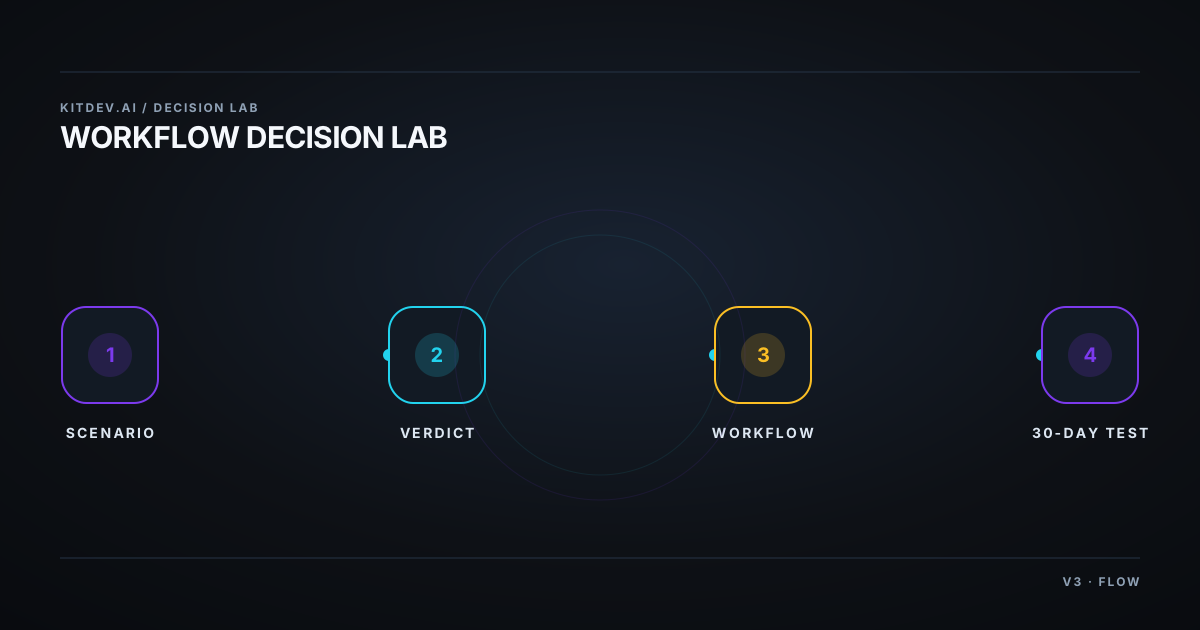
The shape of these articles is the point.
The software and AI advice available to a small-business owner is almost always one of two things: a vendor’s marketing page, or a “10 best CRMs” listicle that was written from the same marketing pages. Neither answers the question you actually have, “should I buy this, for my business, at this price, before I waste a week setting it up?”
The Workflow Decision Lab is built to answer that. The standard for this site is a four-part argument:
- A named scenario, not a category. “A 2–15 person plumbing shop that loses after-hours leads,” not “SMBs.”
- A verdict up front. What we’d do, and for whom. If the answer is “buy nothing, fix this for $0 first,” that’s the verdict.
- The workflow, visible. The actual steps, the cost shape, the failure modes, the part demos skip.
- The keep-or-drop rule. The metric that decides, and the condition for keeping it. Not a revenue promise.
The two pieces below run the full standard, so you can check the format against real articles:
| Article | Named scenario | Verdict | Keep-or-drop |
|---|---|---|---|
| Railway vs Fly vs Render | Nora’s 512 MB-class always-on API | Fly.io at $3.52/month | Measure 30 days of usage before moving |
| Jentic One | An agent calling a small set of external APIs | Sandbox pilot on a separate host | Verify the gates before real credentials go behind them |
The one rule everything else follows
No claim without a receipt.
If a cost figure, a tool rating, or a performance number appears here, it either links to a real source (a pricing page, a command output, a recorded call, a decision record) or it is explicitly marked unverified or to be captured from a live test. You will see those markers deliberately left in an article. That’s not an embarrassment. It’s the difference between a cost table we ran and a cost table we made up. A fabricated number on a buying decision is worse than no number, because you’ll build a budget on it.
What this is not
- Not a tool comparison site. We compare approaches (built-in AI vs standalone SaaS vs no-code vs custom vs “fix the process first”), because the right kind of solution matters more than the right brand.
- Not sponsored. Nothing here is paid placement. There are no affiliate links doing the ranking.
- Not “we’re an AI agency.” We’re a working AI engineer publishing what we’d tell a friend who owns a business. The product, when there is one, will be built on top of the research, not sold as it.
The roadmap is the content
The Lab is organized by business vertical, home services first, then e-commerce, agencies, bookkeeping, local retail, professional services. Each vertical leads with the single decision that most often wastes money before anything else. When you see a vertical marked coming soon, it’s not a tease. It’s the next test to run.
If there’s a decision you’re sitting on right now, tell us. It moves up the list.
More on this decision, three ways to look at it:
Related posts
Agent Memory Needs Typed Claims, Routing, and Maintenance
A three-month GBrain + Hermes run: why raw transcripts are not memory, and the typed-substrate, routing, and maintenance loop that made durable recall inspectable.
Your AI Ops Bot Is Not Your Co-Founder: Guardrails First
Letting an agent touch production needs blast-radius limits, not trust. The guardrails to set first, the failure modes they stop, and where to keep a human.
LLM Fine-Tuning: Your Dataset Is the Hard Part, Not the Run
For an internal smart-contract audit SFT lane, hold the run until the dataset passes dedup, leakage, grounding, negative-coverage, and truncation gates.
Get the next verdict before it's everywhere.
One email when a new lab post or cost table ships. No spam, no confirmation step — unsubscribe anytime.