Self-Hosted LTX 2.3: Failure Modes and Trade-Offs
Receipt-backed LTX 2.3 and ComfyUI workflows show the GPU, retry, and failure-mode trade-offs behind self-hosting versus an occasional hosted API call.
Filed under Local LLM Inference· see every report on this topic
Verdict: A YouTube channel or small ad studio producing N scenes per week should consider local LTX 2.3 + ComfyUI when repeatable scenes, local-language control, and retained assets matter more than operational simplicity. Use a hosted API for an occasional English hero video. The receipts cover a German Klima-Taler ad workflow and an eight-scene Hindi true-crime line; they do not include a controlled local-versus-API quality test, per-scene dollar ledger, or public channel results.
This is a 96GB GPU, latent workflow, TTS, FFmpeg, subtitles, retries, and one job at a time. It only wins when that production line is the work you need.
The operator is buying a production line
A two-person channel or small ad studio makes connected scenes, not isolated clips. The unit of work is a shot list that becomes narration, scene files, assembly, captions, and a publishable cut.
The useful choice is occasional generated shot versus repeatable multi-scene line. A hosted endpoint removes machine work but makes its request surface, language support, pricing meter, and asset lifecycle part of the workflow. A local line replaces that dependency with a GPU lane and more moving parts.
projects/video-factory records an LTX 2.3 pipeline on an RTX PRO 6000 with 96GB VRAM: development checkpoint, distilled LoRA at scale 0.2, MultimodalGuider, LTXVConcatAVLatent, SamplerCustomAdvanced, and ManualSigmas at nine steps. Portrait generation was 544×960, 121 frames, 24fps, and roughly 45–60 seconds per scene. It is an operator estimate, not a latency distribution. p50, p95, and retry rate remain unverified.
The LTX line has a real shape
The local line starts with a scene plan. The read-only inspection on 2026-08-21 found /home/kit/projects/klimataler-ad-ltx/plans/redo_plan.json with duration_sec, voiceover, and scenes, including six scene entries. It also found Kokoro WAVs, including /home/kit/projects/klimataler-ad-ltx/audio/voice_kokoro_30s.wav at 4,531,982 bytes. The directory was 121M. The job has plan, narration, render scripts, logs, and source assets.
projects-klimataler-ad-ltx records a German Klima-Taler savings-product ad with a 30.0-second, 1920×1080, 24fps final; first I2V clip 960×544 for 5.04 seconds; and 26.5-second generated voiceover. This is a historical ledger. On 2026-08-21, /home/kit/projects/klimataler-ad-ltx/ had no matching final MP4, so direct ffprobe confirmation of the 30.0-second final is unverified. The discovered ComfyUI candidates were 960×544 at 24fps but 2.708333 seconds each, not the ledger’s 5.04-second first clip.
A second workflow shows repetition, not performance. Inspection of /home/kit/projects/videochannels/true-crime-hindi/scenes/ found eight MP4s: burial, confession, disappearance, evidence, hook, mother, search, and unsolved. It found eight matching WAV voiceovers under voiceover/ and reusable artifacts under workflows/, including hook_workflow.json. ffprobe returned 4.840000 seconds for six scenes, 2.920000 for hook, and 6.760000 for unsolved. Views, CTR, retention, revenue, and a finished public upload are unverified.
Hindi delivery uses mms-tts-hin VITS, FFmpeg aformat rather than unavailable afmt, and a separate subtitle pass (projects/video-factory). The path is script and plan → per-scene voice → visual generation → mux/assembly → caption polish. Native audio adds another seam to inspect.
Pick an approach by repeated work
This compares operating shapes, not vendor quality. Provider prices and third-party claims were not captured in this run.
| Approach | Good for | Cost shape | Boundary |
|---|---|---|---|
| Hosted video API | Occasional English hero shots | Per-credit/credit-pack; pricing to be verified | Provider request and language boundary |
| Open-source hosted | Burst experiments without GPU ownership | GPU-per-second; pricing to be verified | Remote meter remains |
| Self-hosted LTX + ComfyUI | Repeatable scenes and localization | GPU attention + electricity; dollars unverified | Shared single-GPU operations |
| Hosted + post pipeline | Hero shots plus local TTS/captions | API generation plus local passes; unverified | Two systems and edit seam |
| Do nothing first | Below an unverified N videos/month | Script, stock, motion graphics | No generated-shot experiment |
A hosted API is the default for one English launch clip when directing matters more than managing a render lane. That means fewer operational surfaces, not objectively better output. We did not test quality, price, or language coverage across providers.
Open-source hosted is the middle rung: a Replicate-class GPU-per-second service gives model access without a workstation. Verify its rate against the exact model, hardware, duration, and queue policy. A credit pack and GPU-seconds are different units.
The local receipts show a line, not free video: a German ad with plan and TTS assets, plus a Hindi channel with eight scenes, eight voiceovers, and reusable workflows. Electricity, hardware amortization, and human retry time were not measured, so per-scene cash cost is unverified. The shared machine also serves LLMs, GBrain, and other stacks.
The hybrid line places visual generation behind an API but keeps local TTS, subtitles, branded assembly, and language corrections. If volume is below a measured crossover, use script, licensed stock, motion graphics, and clean narration. Run one test scene before buying hardware, credits, or automation.
Failure modes are the product
| Constraint | Receipt | Operator action |
|---|---|---|
| Geometry | Width and height divisible by 32 | Validate before render |
| Duration math | Frames are 8n + 1; 121 is about five seconds at 24fps | Align edit beat and input rule |
| AV latent seam | LTXVConcatAVLatent and required audio-video latents |
Treat voiced inputs as coupled |
| Stage-two denoise | 0.35–0.55 band; above roughly 0.7 can overwrite motion | Do not equate more denoise with fidelity |
| Captions | Separate project pass | Budget a finishing stage |
| Shared GPU | One lane, no queue or SLA | Treat render wall-clock as attention cost |
Geometry, duration, AV-latent, and denoise constraints come from research/ltx-2-3-comprehensive-technical-reference. The shared workstation also runs LLM and GBrain services (infrastructure/ai-workstation); measured queue wait and service availability are unverified.
There is no controlled local-LTX versus hosted-API quality evaluation, blinded reviewer set, matched-prompt study, or edit-time comparison. These receipts show repeatability and control, not “local looks better.”
When not to build the factory
Skip self-hosting when the decision is an occasional asset rather than a content system, English is enough, the deliverable is one hero shot, or the GPU cannot be busy while serving another workload.
Also skip it when the limiting factor is script, narrative, source footage, or edit judgment. Eight scene files do not equal a channel; the true-crime evidence proves workflow repetition and leaves public performance unverified. Start with one scene and use stock or motion graphics until workflow, rather than model, is the bottleneck.
MoneyPrinterTurbo was forked on 2026-08-19 at creation commit d4c0e45 (projects/moneyprinterturbo). That is a fork receipt only. Execution, customization, and output are unverified.
Bottom line
Self-hosted LTX 2.3 plus ComfyUI supports a narrow claim: repeatable scene-based work on one 96GB RTX PRO 6000, backed by one German ad workflow and a separate eight-scene Hindi artifact. The value is line control and localization options, not proved quality superiority or zero marginal cost.
For an occasional English hero video, pay for the API. For a multi-scene channel where local-language finishing and per-scene control are the product, build the factory only after a baseline week shows the shared GPU lane costs less attention than the credits avoided.
FAQ
Can I self-host AI video generation on one GPU?
Yes. Our LTX 2.3 and ComfyUI project ledger uses one RTX PRO 6000 with 96GB VRAM (projects/video-factory). But one GPU means one shared lane, no queue, no SLA, and active attention during failures.
What does an LTX 2.3 scene actually cost in time?
The project ledger records roughly 45–60 seconds for a 544×960, 121-frame, 24fps scene. Dollar cost, latency distribution, and retry rate are unverified because this run did not capture them.
When should I use a hosted video API instead?
Use an API for occasional English hero shots when a simple request path matters more than local control. Use a local or hybrid line for repeatable multi-scene work, especially localization, only if you accept GPU and workflow operations.
Does self-hosted LTX look better than hosted video APIs?
We did not run a controlled quality comparison. These receipts show repeatability, workflow control, and local language handling, not quality superiority.
Receipts
projects/video-factory, LTX workflow settings, Hindi TTS, separate subtitle pass, scene-time estimate, RTX PRO 6000 context.projects-klimataler-ad-ltx, historical German ad duration, resolution, FPS, first-clip, and voiceover ledger.research/ltx-2-3-comprehensive-technical-reference, geometry, frame, AV latent, and refinement constraints.- PC inspection, 2026-08-21.
/home/kit/projects/klimataler-ad-ltx/and/home/kit/projects/videochannels/true-crime-hindi/scenes/; direct final-adffprobeverification remains unverified because the matching final MP4 was absent from the inspected directory. projects/moneyprinterturbo, fork record only; no production-run claim.
More on this decision, three ways to look at it:
Related posts
LLM Fine-Tuning: Your Dataset Is the Hard Part, Not the Run
For an internal smart-contract audit SFT lane, hold the run until the dataset passes dedup, leakage, grounding, negative-coverage, and truncation gates.
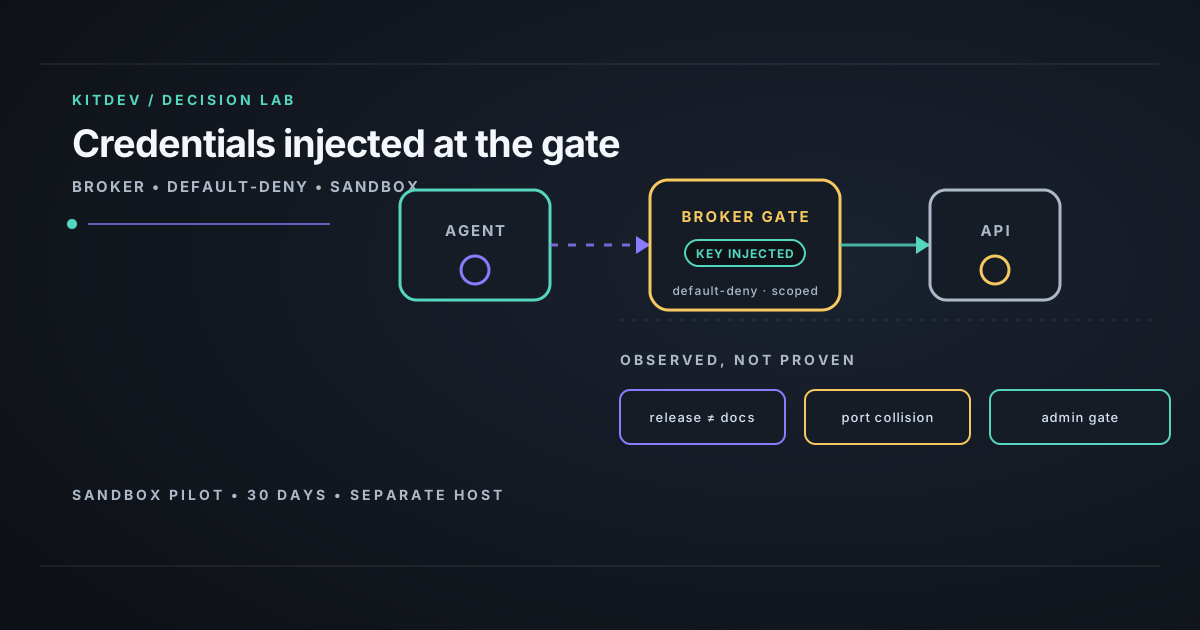
Jentic One, Tested: Three Install Failures, Then a Sandbox Pilot
A shared-host Jentic One install hit release drift, a false health check, and an admin gate before any governed API call; here is what each one costs.
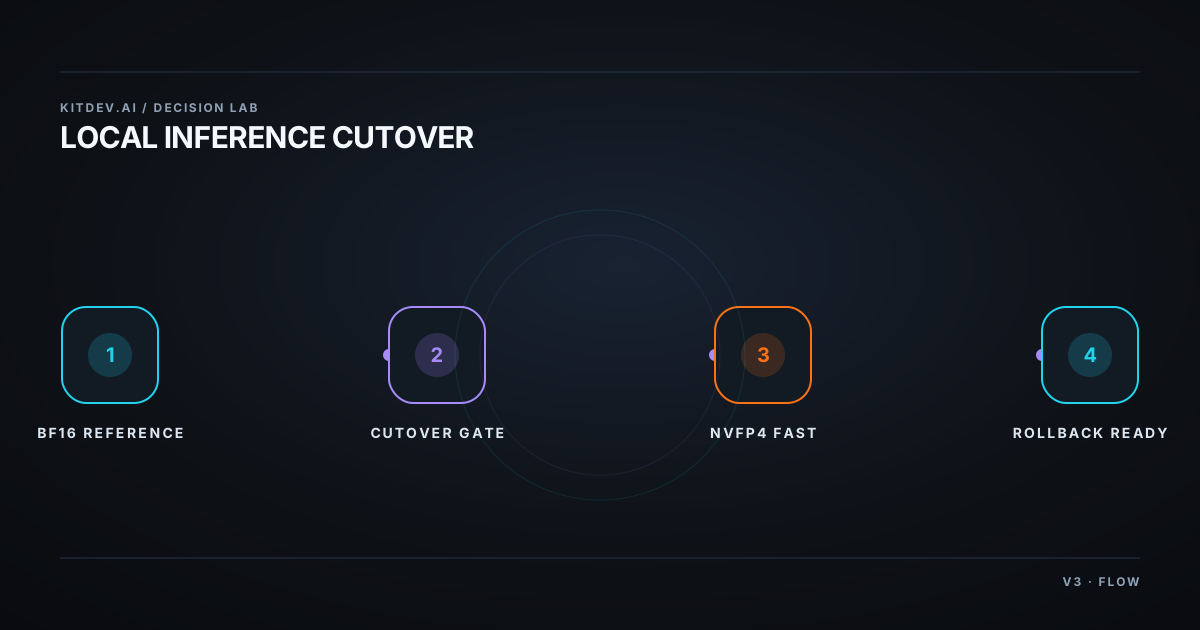
96GB Blackwell: SGLang NVFP4 + DFlash2 vs vLLM BF16, Measured
Measured Qwen3.8-27B serving on one 96GB Blackwell GPU: a BF16 vLLM baseline, an NVFP4 SGLang lane, and the throughput and latency that decide which holds.
Get the next verdict before it's everywhere.
One email when a new lab post or cost table ships. No spam, no confirmation step — unsubscribe anytime.