Merchant of Record: Stripe vs Paddle vs Lemon Squeezy
A $3,000/month model comparing Stripe, Paddle, and Lemon Squeezy on merchant-of-record responsibility, fee math, migration risk, and when direct Stripe wins.
Filed under Decision Guides· see every report on this topic
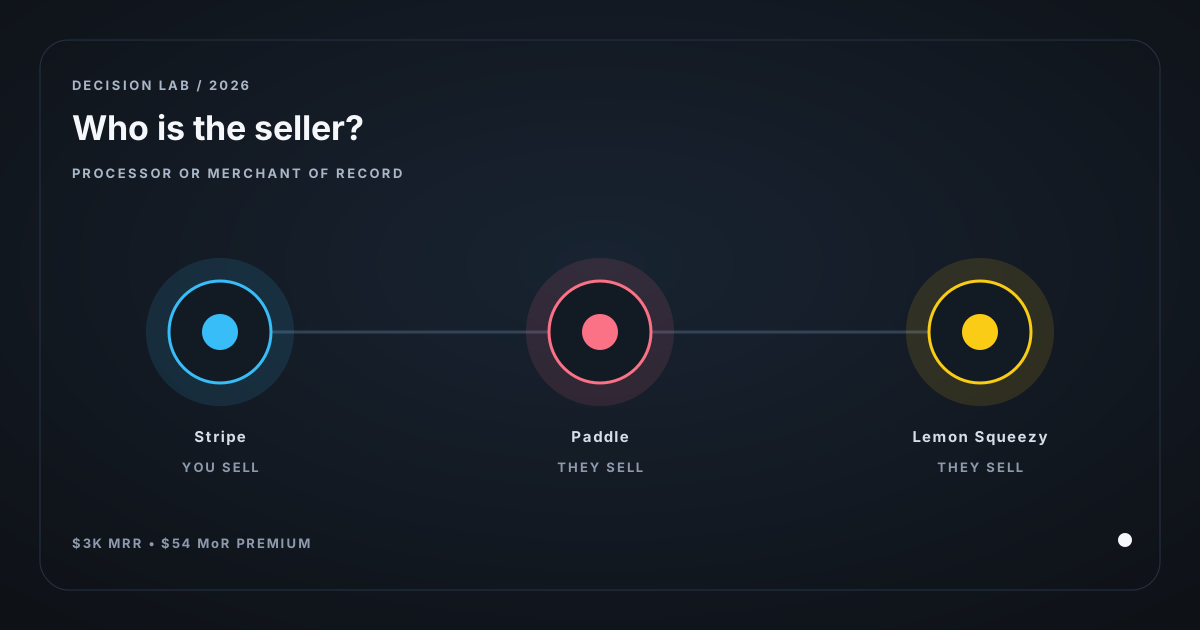
Verdict. Pick Stripe standard Payments if you want to own payments and the tax-compliance work of being seller. Pick Paddle if you want a merchant of record to do that job. Lemon Squeezy makes the same trade for indie software, but Stripe acquired it and is moving toward Stripe Managed Payments. In the model below, Paddle or Lemon Squeezy costs $54/month more (as of 21 Aug 2026) than direct Stripe. Decide whether avoiding tax registration, filing, remittance, and transaction liability is worth that amount.
Proof status. Vendor prices come from vendor pages on 21 August 2026 and each vendor price is linked. The worked example labels its MRR, order values, transaction count, geography mix, and compliance hours as model inputs, not measured vendor facts. Lemon Squeezy’s current pricing page is live and quotes current pricing; its 2026 update says Stripe acquired it and directs interest toward Stripe Managed Payments. Recheck links before publishing or signing an annual commitment.
1. The operator and the leak
Aisha is a solo founder with a B2C micro-SaaS. She sells subscriptions and a one-time add-on. A meaningful share of customers is in the EU, UK, and markets outside her home country.
She needs recurring billing without a second job of reconciling location evidence, watching thresholds, registering, filing returns, and remitting tax. “Stripe is cheaper” misses a cost: with direct Stripe, you remain the merchant. Paddle and Lemon Squeezy charge more because they become the MoR, legal seller to the buyer with tax and payment liability.
2. Separate processor from merchant of record
| Provider | Transaction structure | Tax and liability role |
|---|---|---|
| Stripe Payments | Your company sells; Stripe processes payment | Stripe Tax calculates/collects and offers filing paths or reports. Managed Payments is Stripe’s MoR product. |
| Paddle | Paddle acts as reseller/MoR | It says it calculates, files, remits software sales tax, and carries liability for those sales. |
| Lemon Squeezy | Lemon Squeezy is MoR | It says it takes tax calculation/collection liability and pays tax on your behalf. Subscriptions and one-time charges are supported. |
A tax calculator can charge the right amount but does not become seller, hold registrations, submit returns, or carry transaction liability. Paddle makes this distinction plainly: a calculator creates a report while liability remains with you.
Lemon Squeezy status: its pricing, subscription tooling, checkout, and 2026 update are live. Its update says Stripe acquired it and points prospects toward Stripe Managed Payments. Treat it as a live product with a migration-risk variable, not a permanently independent Stripe alternative.
3. Compare published fees
| Provider | Published price | What you buy |
|---|---|---|
| Stripe Payments | 2.9% + $0.30 domestic card; plus 1.5% international card (as of 21 Aug 2026) | Processor. You remain seller/MoR. Stripe Tax can calculate, collect, and support filing, but does not change seller role. |
| Paddle | 5% + $0.50 per Checkout transaction (as of 21 Aug 2026) | Merchant of record. Payments, subscriptions, tax compliance/remittance, fraud/chargeback protection, payment support. |
| Lemon Squeezy | 5% + $0.50 per transaction (as of 21 Aug 2026) | Merchant of record for digital products. Tax collection/remittance, subscriptions, one-time products. Some payments add fees. |
The model includes Stripe’s international-card surcharge and assumes no currency conversion. Stripe lists conversion as an additional fee; do not reuse this model if you need it. Paddle flags custom pricing for low-value products or invoicing, and Lemon Squeezy says some payments add fees. Verify country, product, and payout route.
4. Run the $3,000 monthly model
Assumptions. Model inputs, not vendor measurements. Aisha has $3,000 MRR: 25 subscription renewals at $80 plus 20 one-time add-ons at $50, or 45 successful transactions. Revenue is 40% international: 12 subscriptions and eight add-ons, or $1,200. Stripe cards are treated as domestic or international exactly as quoted. The model excludes refunds, disputes, taxes, currency conversion, alternative payment methods, and custom/volume pricing.
| Provider | Calculation | Effective fee on modelled $3,000 |
|---|---|---|
| Stripe Payments | 2.9% × $3,000 + 1.5% × $1,200 intl + $0.30 × 45 | $118.50, 3.95% |
| Paddle | 5% × $3,000 + $0.50 × 45 | $172.50, 5.75% |
| Lemon Squeezy | 5% × $3,000 + $0.50 × 45 | $172.50, 5.75% before payment-specific fees |
All vendor rates are from 21 Aug 2026; results are derived from cited inputs, not vendor totals.
The MoR premium in this mix is $54 per month (derived from Paddle’s and Stripe’s cited inputs; as of 21 Aug 2026), or 1.8 percentage points of MRR. The rough “about two points” rule holds here because this model has a specific transaction mix behind it.
Add an explicit time line: direct Stripe assumes four hours/month for registrations/threshold review, evidence and records, return preparation, remittance coordination, and reconciliation. MoR assumes half an hour/month for payout and reverse-invoice review. That is 3.5 assumed hours saved, not a measured vendor workload.
Choose MoR when those 3.5 hours plus bought-out liability exceed $54/month (derived from cited inputs; as of 21 Aug 2026). In time alone, the model crosses at $15.43/hour (derived from the cited fee inputs; as of 21 Aug 2026). A narrow domestic business with a real finance process can rationally choose Stripe instead.
5. Plan for the failure modes
| Failure | What to check |
|---|---|
| MoR migration treated as a checkbox | Payment credentials, subscriptions, invoices, dunning history, webhooks, portals, and seller name all need a plan. Paddle says data can migrate. |
| One fee applied to all payments | Recalculate from a real month of charges. The model uses cards; Stripe has international and possible conversion fees, Lemon Squeezy may charge extra. |
| Fee gap assumed to scale universally | There is no universal MRR crossover. This model’s $54 per month (derived from cited inputs; as of 21 Aug 2026) applies at $3,000 MRR. |
| Tax calculation treated as outsourcing | Stripe Tax is useful tooling; direct Stripe leaves the seller responsible for compliance. Paddle/Lemon Squeezy change transaction structure. |
Migration matters more with Lemon Squeezy’s Stripe-owned roadmap transition. Plan it before it becomes urgent.
6. When not to use a merchant of record
- Nearly all sales sit in one jurisdiction and an accountant plus filing process already owns the work.
- The product needs payment flows, invoicing, contract terms, marketplace mechanics, or billing that an MoR cannot support as cleanly as direct Stripe. Validate the exact workflow, not a feature checkbox.
- B2B contracts require you, rather than a reseller, as contracting seller, or buyers need a specific invoicing/tax structure. Get legal/tax advice.
- A durable independent vendor relationship matters and the Lemon Squeezy/Stripe transition creates an unacceptable risk. My take: Paddle is the cleaner MoR comparison for that decision.
Bottom line
Standard Stripe is processor-led: you own the seller and tax-compliance programme. Paddle and Lemon Squeezy are MoR-led: the provider sells the transaction and takes on that work and liability.
For Aisha’s model, the handoff costs $54/month (derived from Paddle’s and Stripe’s cited pricing inputs; as of 21 Aug 2026). Pay it if saved compliance time and liability exceed the price. Keep Stripe if your process, scope, and need for control justify owning it. Lemon Squeezy is live, but Stripe owns it and is building the next MoR path, so include migration design in the first decision.
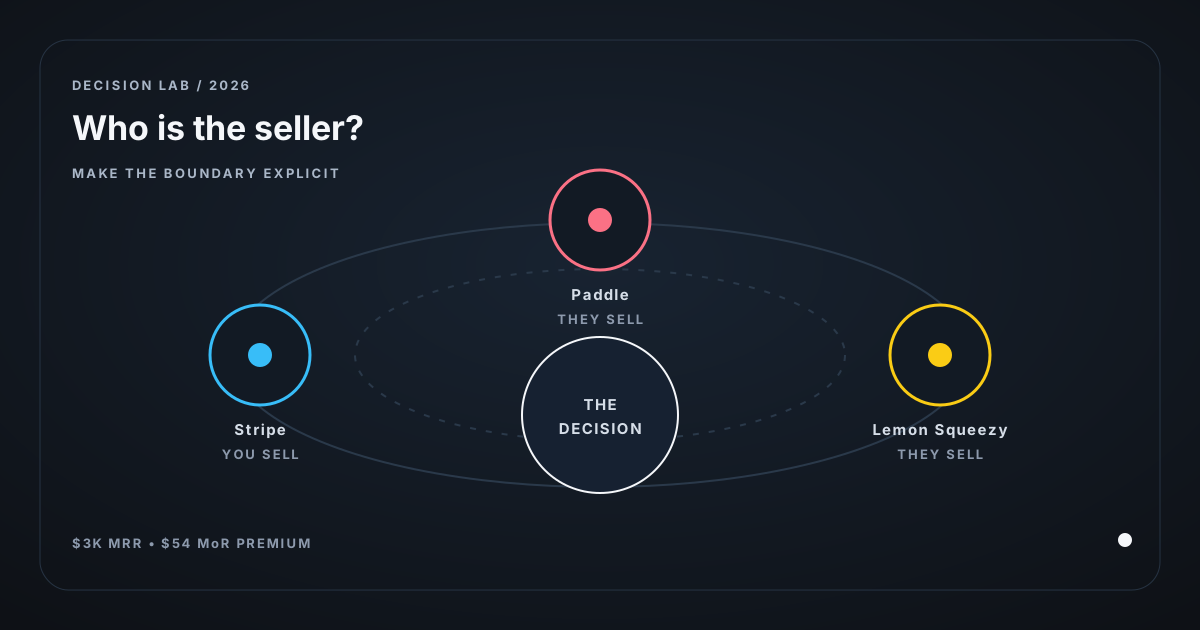
More on this decision, three ways to look at it:

Related posts
LLM API Pricing for a Micro-SaaS: Price the Workload
Price LLM APIs by successful workflow, using dated token rates, a 100,000-completion cost fixture, batch discounts, and explicit self-hosting limits.

Railway Hosting vs Render vs Fly.io: Billing Compared
How three hosts bill the same micro-SaaS: utilization, provisioned VM, and fixed service size. Dated prices, a worked example, and the keep-or-drop rule.
Agency Reporting: $0 Looker Studio Before Paid Tools
Client reporting for agencies: the free Looker Studio floor, the per-client math on paid tools, and why fixing inconsistent inputs beats any AI commentary.
Get the next verdict before it's everywhere.
One email when a new lab post or cost table ships. No spam, no confirmation step — unsubscribe anytime.